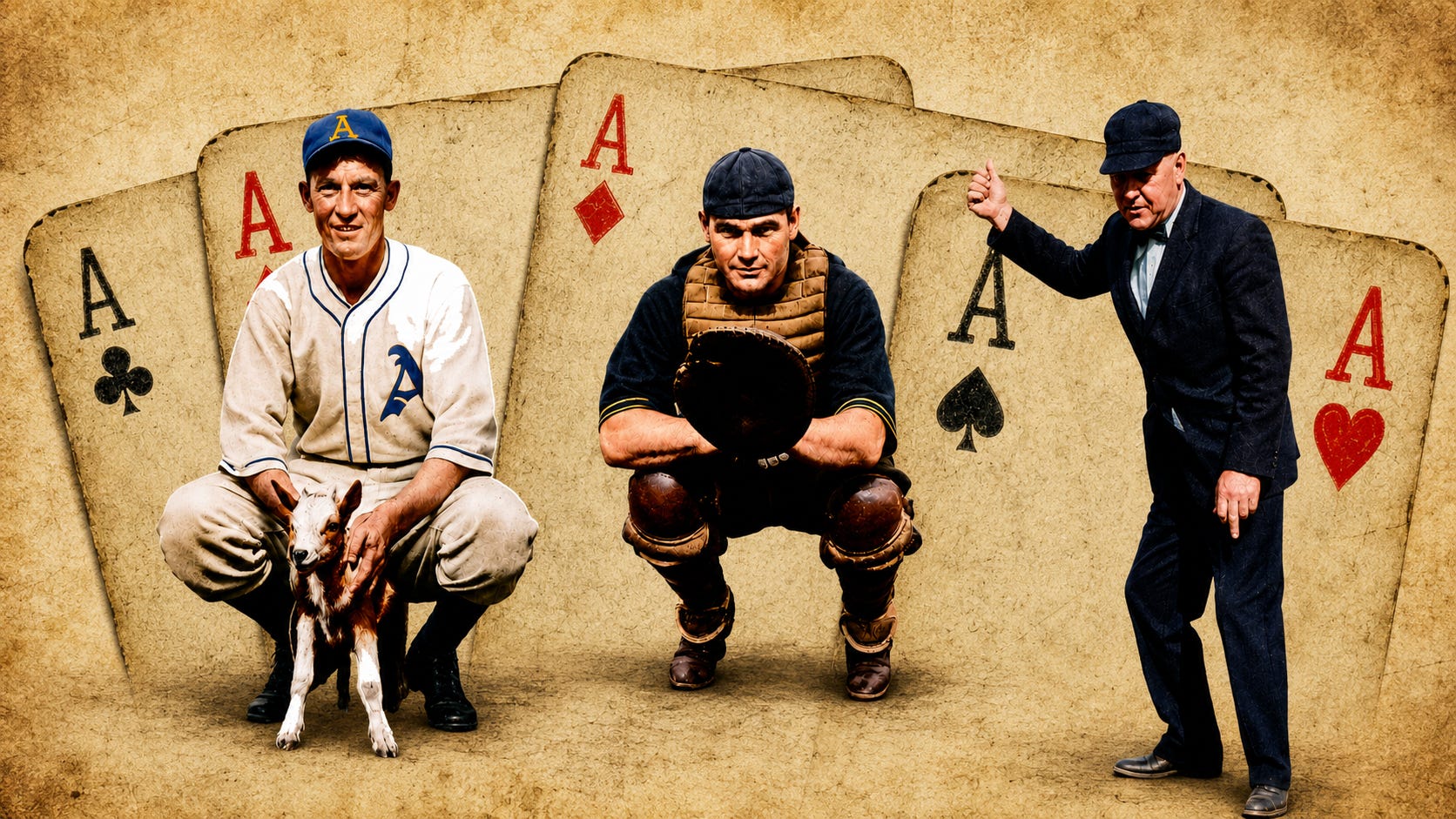
A Baseball Town on the Brink: Drawing the Aces
Alexandria did not stumble into the Evangeline League. It had to be recruited, with conditions: local money, outside experience, a manager with something to lose, and a ballpark question.

This is the third installment in a multi-part series on Bringhurst Field and the long, improbable history of organized and professional baseball in Alexandria, Louisiana.
Part I began near the end of the story’s most haunting chapter: Andy Strong’s final night at Bringhurst Field. Part II returned to the years before Bringhurst, when Alexandria was already a complicated baseball town: a city of Black ballparks, white professional clubs, summer crowds, unpaid bills, river names, red ink, and one lost team it could not quite forgive.
By 1933, Alexandria had not stopped being a baseball town. It had become a more cautious one. Black Alexandrians had built their own baseball institutions under segregation, including a purpose-built ballpark before Bringhurst existed. White Alexandrians had watched a professional club make them proud, develop future major leaguers, finish first, and then vanish under the control of outside baseball interests. Paul Gilham had kept the old Reds name alive, but only in a smaller, safer form.
The city did not need to be taught to love baseball.
It needed to be convinced that professional baseball could return without betraying it again.
“Ye who believe in affection that hopes, and endures, and is patient.”
—Henry Wadsworth Longfellow, Evangeline: A Tale of Acadie, 1847.
By early 1934, U.S. Sen. Huey P. Long had become Louisiana’s most dominant political figure and a national phenomenon: left-leaning, populist, comic, and volcanic. He had converted working-class resentment and Depression-era desperation into theater, and the performance terrified his enemies. Privately, President Franklin Roosevelt considered him to be one of the two most dangerous men in America.1
But the smaller drama that matters here did not occur in the Senate cloakroom or in Long’s private apartment on the 24th floor of the new state Capitol in Baton Rouge.2 It unfolded in the bayou villages and prairie cities of Louisiana, where roads built by the Kingfish were shrinking the distance between communities while enlarging the scale of their ambitions.

In early March 1934, an eclectic group of delegates—small-town mayors, ambitious merchants, bank executives, baseball journeymen, and farmers—gathered at the Elks Lodge in New Iberia to give Louisiana a new professional baseball circuit. They were led by Frem Boustany, Sr.,3 a Lebanese immigrant, rising civic entrepreneur, and the owner of the Lafayette White Sox.
A year before, in 1933, Boustany’s White Sox were not yet a professional minor-league franchise, but he made them look like one. He and his partners raised private money, built Parkdale Park, sold the town on the club, and paid for players good enough to turn a semi-pro team into a regional sensation. The White Sox sold out home games, won fifty of their seventy contests, and beat the New Orleans Pelicans, a Class A Southern Association club that finished second in its league that year.4 Lafayette’s success became the argument for a brand-new loop, box-office proof that small Louisiana cities would pay to see good baseball.
The name of the new Class D loop was both borrowed and burnished: the Evangeline League, after Longfellow’s exiled Acadian heroine.5 Reportedly, it had been suggested by Art “Dugan” Phelan, the former Chicago Cubs and Cincinnati Reds third baseman who would soon manage and co-own the club in Alexandria.6 Phelan was no Cajun sentimentalist. He was an Illinois native with Texas ties, a baseball lifer who understood that stories sold tickets.
By then, Evangeline had already become one of South Louisiana’s most marketable public myths. Ten miles north of New Iberia, St. Martinville had been laying claim to Longfellow’s legend since the late nineteenth century. Then, in 1907, Louisiana judge Felix Voorhies gave the legend a local address and a set of proper names. In Acadian Reminiscences: The True Story of Evangeline, Voorhies recast Longfellow’s Evangeline and Gabriel as Emmeline Labiche and Louis Arceneaux, real-life Acadian lovers whose long-delayed reunion, he claimed, occurred beneath an old oak on the banks of the Teche. In his hands, a poem became a genealogy, a tree became a shrine, and a folk tale became civic fact.7
Huey Long recognized the value of that shrine. During the 1928 governor’s race, he stood beneath the Evangeline Oak and turned a nineteenth-century poem into a political instrument. Evangeline, he told the crowd, had waited for Gabriel. South Louisiana had waited for schools, roads, bridges, highways, and public institutions that never came. In Long’s hands, the Acadian heroine became a witness for the prosecution. The oak was no longer merely a relic of local romance. It became a stage where neglect could be named and answered with a promise.
That promise did not create the Evangeline League. Long had no known hand in organizing the circuit. But his Louisiana—the modern Louisiana of roads, spectacle, resentment, and municipal ambition—helped make such a league plausible.
The six original cities—Alexandria, Opelousas, Lafayette, Rayne, New Iberia, and Lake Charles8—could become not merely towns with teams, but a circuit.9
“Baseball in the Evangeline country has just about got a monopoly on sporting affairs for the summer and, with fine roads connecting all the cities, almost every game played in every town holds interest for every other town in the circuit.”
—Bill Keefe of The Times-Picayune, 1937.
While smaller towns like Rayne were willing to spend heavily for a place in the Evangeline League, Alexandria had to be recruited before it would even consider endorsing a new franchise. Professional baseball may have been good fun, but it wasn’t necessarily good business. Between 1925 and 1930, a group of local investors sank more than $50,000 (over $1 million in today’s dollars) to prop up the Reds,10 only to watch the team disappear under the control of an out-of-town executive.11 A new baseball club would need to be a civic investment and could not be obsessed with turning a profit, The Town Talk cautioned in February 1934, because no one was “going into the business to make money, but rather to give Alexandria clean, wholesome sport and considerable national publicity.”12
Despite the newspaper’s high-minded appeal, there wasn’t much homegrown enthusiasm for an Evangeline League team. Mayor Victor V. Lamkin, who, as a banking executive in 1920, had served as a director of the Alexandria Baseball Association,13 the same organization that would eventually lure the Alexandria Reds of the Cotton States League to town,1415 didn’t join the delegation down in New Iberia when the circuit was officially formed in early March. In fact, with the exception of The Town Talk’s Ralph Brewer, no one from Alexandria was present when it was named as a charter member of the new league.
The decision to include Alexandria was largely the result of an aggressive, singularly focused lobbying effort led by the Southern Division Promotions Director of the National Association of Professional Baseball Leagues, J. Walter Morris of Dallas, Texas. In barely three months, Morris assembled the parts Alexandria required: a league, a local case for lower costs, prospective owner-managers, and enough civic permission to proceed.
A University of Texas alumnus who briefly played shortstop for the 1908 St. Louis Cardinals and one of the South’s most active minor-league organizers, John Walter Morris gave Alexandria’s proposed Evangeline League franchise instant credibility. “I organized more leagues (14 in total) than any other man,” Morris later boasted, “and was president of more (seven) than anyone else.”16
Morris adamantly believed in Alexandria’s potential as a baseball town. He first floated the idea of the city joining a new league during a visit on January 5, 1934, two months before the conclave in New Iberia. He knew the city’s history with the Reds and understood that he was recruiting a reluctant market. Alexandria had already learned the hard way that grand talk, opening-day enthusiasm, and civic pride could not by themselves meet a payroll. So his task was not merely to persuade Alexandria that baseball was worth having. It was to persuade Alexandria that this time baseball could be made sane. “There is a great difference between minor league operations today and that prior to 1930,” Morris told The Town Talk. “Operating expenses have been whittled, and with the proper management and a fair team, any town this size can afford professional baseball.”17
Originally, Morris had hoped to position Alexandria as the hub of a new loop that would also include Baton Rouge, Shreveport, Monroe, Vicksburg, and Jackson, but only a month later, that configuration was shelved in favor of grander plans for a regional Class C league, centered on the structure of the old Dixie League, with eastern and western divisions.18
On February 4, 1934, Morris presided over a meeting in Monroe in which plans for the eight-team Eastern Division of the revamped Dixie League were publicly announced. Representatives from six cities—Shreveport, Monroe, Baton Rouge, Jackson, El Dorado, and Pine Bluff—were on hand to declare their commitment to finance a team. A seventh team, in Greenville, Mississippi, was nearly locked in. That left one open spot.
For Alexandria, the important point was not the name of the proposed league. It was the map.
During the meeting in Monroe, Morris officially appointed a committee tasked with contacting “various interests” in Greenville and two other towns, Vicksburg and Alexandria, “to promote a club for the league.” Before adjourning, Morris had one last announcement: Later that week, he would travel to South Louisiana and organize another league, a smaller, regional Class D league.
But given Alexandria’s well-known reluctance, it wasn’t surprising that local boosters weren’t forthcoming about supporting a team tied to a league that would be geographically remote and dominated by larger cities. Morris likely anticipated this. Before he visited South Louisiana, discussions there of a new league had centered on “Lake Charles, Jennings, Rayne, Lafayette, Opelousas, New Iberia, Abbeville, Patterson, and Morgan City.”19 After his trip, the proposed “Louisiana State League” was pared down and more refined. It would be a six-team Class D loop, with the ability to expand to eight teams. Five cities had already been selected, and on February 12, they officially invited Alexandria to become the sixth and final charter city in the new, still-unnamed Louisiana league. Morris’s fingerprints were all over the redefined circuit. Alexandria, he predicted, would be the “best baseball city in the new league.”20
He didn’t sell the proposed league as a revival of the old order. He sold it as a correction. The problem with joining the reconstituted Dixie League, Morris conceded, was geography: Alexandria would have been placed in an eastern division with teams as far away as Pine Bluff, Arkansas (237 miles apart) and Jackson, Mississippi (177 miles apart). The Evangeline League would be smaller, cheaper, more regional, and more honestly suited to the economics of Class D baseball. “While the league will be Class D, same as the old Cotton States League, traveling expenses, salaries, and operating overhead will be about one-fourth as much,” The Town Talk reported.
Alexandria didn’t need to pretend to be Shreveport, New Orleans, or Houston. It simply needed to be what it already was: the largest and most commercially substantial town in Central Louisiana, a place with enough pride, newspaper muscle, and baseball memory to anchor a league of its own. Morris was offering Alexandria a way back into organized baseball without asking it to forget why it had left.
J. Walter Morris was up against the clock. The league would need to be operational by early April to play in tandem with the major leagues and the rest of the minors.
Wisely, he understood that he could convince the community only if he first convinced a group of local baseball boosters led by Paul A. Gilham, Sr., and he shrewdly deferred to Gilham and company in defining his proposal. Gilham, the president and founder of Alexandria Coca-Cola and one of the local investors jilted when Ollie Lee Biedenharn21 disbanded the Alexandria Reds in the middle of the 1930 season, had established the semi-pro Central Louisiana Baseball League in 1931, extending the afterlife of the Reds as an amateur club and ensuring the game’s continuity.
Gilham had conditions. On February 13, one day after Alexandria received its invitation to join the new circuit, he told Morris to find a manager willing to invest at least $500 in a new $1,000 corporation. The manager would not merely run the team. He would own part of it. The point was control. A manager with money in the club would be harder to discard, and local investors would be less likely to surrender the team to another Biedenharn. In exchange, Gilham, along with Steve Lymberis, a respected restaurateur and Greek immigrant, would help raise funds for the construction of a new ballpark. It was the closest Morris would ever get to local financial backing, but it was crucial.
Morris had already pitched Alexandria on one potential manager, Fred Nicholson, a former big league utility player who, at 39, was just coming off of a banner season as an outfielder for Baton Rouge’s Class C team. “Nicholson was interested in Texarkana and was trying to put that city into the western half of the Dixie League this year,” Morris told The Town Talk when he visited Alexandria in January, “but I think his deal fell through, and if he hasn’t landed anything else he may come over to Alexandria and investigate the conditions here.” Gilham sent Morris a telegram to ask “if Nicholson would consider going fifty-fifty on the local club with a number of fans.”22 At that point, however, Nicholson had inked a deal with Texarkana, and Morris had already moved on to other prospective candidates.
“You shall know the truth, and the truth shall set you free, but you will never get to know the truth by reading the Alexandria Town Talk.”
—Gov. Earl K. Long
Earl Long’s jab was political theater, but it points toward the central problem of this chapter: In Alexandria, The Town Talk was never merely an observer. When baseball returned, the newspaper was part of the machinery.
In his 2005 book Talk of the Town: The Rise of Alexandria, Louisiana, and the ‘Daily Town Talk,’ historian Frederick M. Spletstoser chronicles the first six decades of what would become one of the most acclaimed regional newspapers in the country by the late twentieth century, The Alexandria Daily Town Talk,23 and the outsize role its ambitious founders, Edgar McCormick and his nephew by marriage, Henarie Morrison Huie, played in shaping Alexandria during the first half of the 20th century.24 McCormick, in particular, extolled his adopted hometown as a “future great,” and while Alexandria would never acquire the status or prestige of a major metropolis, the paper’s unapologetic boosterism defined the city’s ethos for decades.
Spletstoser’s book, which was supported in part with funding provided by former publisher—and husband of Henarie Huie’s granddaughter, Jane—Joe D. Smith25 had been conceived as the first of a two-volume work, tracing the paper from its founding in 1883 to the end of the Second World War in 1945, but unfortunately, Spletstoser, a professor emeritus at William Jewell College in Missouri who passed away from cancer in 2012, never completed part two.26 That’s a shame, not only because the second volume would have allowed Spletstoser to focus on the paper’s “glory years” and its role in setting the civic discourse during the decades of social upheaval and the civil rights movement, but also because it would have offered another chance for Spletstoser to consider the career and the contributions of Ralph Brewer, who, shortly before World War II, became the paper’s third-ever managing editor, a position he held until he retired for health-related reasons in 1952.
A Georgia native who was poached from the New Orleans States by Henarie Huie himself in 1920, Brewer began his career at The Town Talk as a “specialist” tasked with curating and editing a selection of reports transmitted by the newly installed Associated Press wire machine. Throughout much of the mid-1920s and 1930s, Brewer worked as the paper’s sports editor, taking a keen interest in the city’s minor league baseball team, the Reds, and, notwithstanding his own potential conflicts of interest, also serving as an official scorekeeper for the Cotton States League.
Although he was not a member of the McCormick-Huie family, Ralph Brewer, who named his youngest child “Paul Huie,” was treated as if he were. During his 32-year tenure, he quietly exerted enormous influence over the paper’s operations, and from his pulpit on the editorial page, he was an unapologetic, sometimes florid, and eternally optimistic promoter of his adopted hometown.
Brewer’s role in the birth of the Evangeline League and the formation of Alexandria’s franchise is easy to overlook or misapprehend, primarily because of his job as a reporter. Indeed, the story of the league’s beginning would be impossible to tell without Brewer’s detailed reports and commentary. He was, more often than not, the only member of the press with access to the esteemed club of baseball men who dreamt up the new circuit and new teams, built rosters, and turned farm boys into star athletes. He was in the room when the league was officially created, at the conclave in New Iberia, not only the sole reporter but also the only person in attendance who actually lived in Alexandria.
To the extent that it was possible, Ralph Brewer wrote himself out of the story, but while he may have never admitted it, Brewer wasn’t merely reporting on the new league and the new team in Alexandria; he was deeply involved in their formation. No one else in Alexandria did more than Brewer to make Morris’s proposal sound less like an out-of-town speculation and more like a civic decision already gathering force.

Behind the scenes, Brewer became an indispensable ally for Morris, far more than a sportswriter standing at the edge of the scene with a notebook. Morris could bring the league plan, the contacts, the baseball map, and the authority of a professional organizer. He knew the minor-league economy and the danger of dressing a Class D club in Class A expenses. Brewer could make the project local. Through The Town Talk, the campaign for baseball could be made to feel less like an out-of-town speculation and more like a civic decision already gathering momentum, a reminder that a baseball city need not remain in exile forever. The paper could summon fans to meetings, introduce the men behind the team, gauge the seriousness of the proposition, and connect the new venture to both the Reds’ old disappointments and Alexandria’s lingering appetite. If Gilham had kept baseball alive in the modest language of amateur schedules and town-lot competition, Brewer helped prepare Alexandria to hear Morris’s larger argument: that professional baseball could return, but only under new terms.
Brewer also knew that Morris would not find Gilham’s required owner-manager by staying inside Central Louisiana. The demand for an owner-manager was business dressed as politics, or politics dressed as business. Intentionally or not, Gilham’s terms complicated the prospect of broad local ownership and gave Morris unusual leverage in selecting the club’s owner-manager. Morris widened the net. By February 19, Fort Worth baseball men Art Phelan and Cecil Coombs were on their way to Alexandria to conduct their own due diligence. Their recruitment gave the proposed club a professional face.
Art Phelan and Cecil Coombs were baseball journeymen in the old honorable sense: seasoned, traveled, fluent in the practical grammar of minor-league baseball. Phelan, who would become a legendary figure in Alexandria, brought the authority of a former major leaguer and a long baseball apprenticeship. Coombs, too, was also a Fort Worth baseball man, a former major-league player, and a minor-league veteran whose presence signaled that Alexandria’s new club would be built from professional experience rather than booster improvisation.
J. Walter Morris had been given the seemingly impossible task of finding a qualified manager willing and able to also assume the role and responsibilities of co-owner by personally investing $500 in Alexandria’s new baseball team. Six days after Gilham’s telegram about Nicholson, Morris returned with not one qualified candidate but two. Phelan and Coombs were willing to put up the required money, though they preferred a corporation in which local investors held a narrow majority.
Once Phelan and Coombs climbed aboard in mid-February, Alexandria’s new team rapidly began to take shape. City officials trumpeted the return of professional baseball, recognizing that Alexandria’s new team signified confidence in the community while handing elected leaders a valuable political gift. The local business community and downtown merchants quickly lined up in support, keen to benefit from the goodwill associated with America’s pastime and from the chance to drive in new customers through cross-marketing.
The grandstands at the old City Park Diamond had burned to the ground a year earlier, leaving Lincoln Park the most obvious and suitable venue, a solution J. Walter Morris had repeatedly supported as practical and obvious.
The ballfield was available. As a result of financial difficulties and amid rumors of mismanagement, the city’s Black baseball team, the Alexandria Lincoln Giants, was dropped from the Negro Southern League prior to the beginning of the 1934 season, though a version of the club continued to play intermittently until it was purchased and relocated later that year. In other words, Lincoln Park could also be used exclusively by the new Evangeline League team.
On Monday, February 19, Phelan and Coombs visited Alexandria for the first time in their capacity as prospective owner-managers, and after touring Lincoln Park, provided a list of improvements they deemed necessary: Relocating the grandstand “out of the sun,” building approximately 20 new box seats, and expanding the overall seating capacity from 1,000 to 1,200.27 “We have investigated the conditions,” the duo reported, “and we are willing to take a chance on Alexandria and this new loop. We want and need help to get the club started, but we are not asking for $10,000. All we ask for is a decent park to play in and a few hundred dollars to go in with our money to organize. We will get all the players we can use.”28
Morris, for his part, had already acknowledged the ballpark needed improvements but cautioned against overbuilding. “It will do,” he declared. “Put a roof on part of the grandstand if you wish. Repair the wire screen and put a ten-foot wire screen over the grandstand to stop foul balls, with a press box behind it, but do not go to any other expense. You can spend $50 and make this park playable, or you can spend $1,000, as you like.” He also specifically advised against adding any new stands. “As long as you have an overflow crowd, the fans will enjoy the game much more. Empty seats never have helped a team on the field or the morale of the fans or business manager. Put chairs or benches or boards along the sidelines when necessary.”29
By the end of February, no public opposition to Lincoln Park had surfaced. It was generally agreed that the purpose-built ballfield near the intersection of Lee and Harris Streets would, with only a few minor repairs and adjustments, offer the new team nearly everything they needed during their inaugural season, and perhaps just as importantly, would provide local officials and investors the insight required to understand where and how much to spend on future enhancements and expansions.
On March 13, exactly one month before Opening Day, prospective players, both rookies and veterans, as well as an assortment of aspiring umpires, groundskeepers, and ticket vendors, began lingering around Lincoln Park and “also around Steve Lymberis, Paul Gilham, and the others interested in bringing back baseball.”30 Three days later, on Friday the 16th, the team’s two skippers revealed they had “already lined up a number of Texas prospects at the Fort Worth baseball school.” Spring training tryouts, they revealed, would begin the following Thursday. Phelan and Coombs encouraged amateurs and semi-pro players to attend spring training, so long as they could pay for their own travel. “We want all the candidates we can get,” the two said in a joint statement, “but of course, they will pay their own expenses. They pay their own transportation and then board themselves while spring training is underway. As for amateurs and semi-pros in this section, we will welcome every one of them with open arms until we get a line on their abilities. When the crowd gets too thick, we will begin to use the pruning knife gently.”31
Phelan and Coombs moved quickly and professionally through an unforgiving assignment of organizing a new professional team in a small market like Central Louisiana, and against a deadline of less than two months, earned both of them immediate respect throughout the community and provided even the most cynical local baseball fans with a tangible reason to believe that Alexandria would not repeat the mistakes of the past. To be sure, Alexandria’s new team was assembled almost entirely by Texans, and Morris became increasingly frustrated by the apparent unwillingness of local officials to participate in league-wide planning meetings. Phelan and Coombs, on the other hand, continued to engage in community outreach and scheduled a public meeting on Monday, March 19, at Paul Gilham’s Coca-Cola plant in order to introduce themselves to the city’s baseball aficionados and answer questions about the city’s new team.
For more than a year, Robert Wilton Bringhurst, Alexandria’s long-serving Commissioner of Streets and Parks, had remained silent about his plans to expand City Park. With little public scrutiny, he had secured an agreement for the City to lease 11 acres of land near the zoo from a local property owner named Louis Daigre, and he kept quiet as Josh Billings, J. Walter Morris, and others discussed the feasibility of using—and improving—Lincoln Park. But on Monday, March 19, he decided to attend the meeting at the Coca-Cola plant and surprise everyone, including the new team’s owners, with an announcement that promised to make Alexandria the crown jewel of Evangeline League baseball.
One of Alexandria’s most respected public officials during the 20th century, Bob Bringhurst, the son of a well-regarded engineer also named Robert Wilton, began his professional career by following in his father's footsteps, working as a civil engineer and surveyor in 1900, at the peak of the lumber boom. The younger Bringhurst rose to prominence partly due to his family’s connection to Jay Gould, the notoriously unscrupulous and extravagantly wealthy robber baron, who owned and operated a lumber mill in Pollock, Louisiana. Bringhurst, who, as a boy, accompanied his father on trips with Gould, managed to remain unscathed by the association. In 1907, he won his first election, a two-year term as city alderman, but decided not to seek a second term in 1909. He returned to public office a decade later after winning a special election to serve the remainder of Irvin McGinnis’s unexpired term as Commissioner of Streets and Parks.32 Bringhurst would handily win the next six consecutive elections, holding the office for a total of 32 years, until his death at the age of 72 in March of 1949.
Although his title, Commissioner of Streets and Parks, may sound dull and bureaucratic, his office carried immense power during the first half of the last century. Bringhurst was responsible for some of Alexandria’s most consequential and transformational projects in the city’s history, and, because of his proactive work ethic and progressive sensibilities, his efforts ensured that Alexandria remained at the forefront of modernization and was a leading proponent of what urban planners today may call “best practices.” Under his watch, Alexandria paved countless streets, developed its first of many master-planned neighborhoods, and maintained a state-of-the-art network of electric trolleys. But Bob Bringhurst’s primary passion was protecting and designing parks. “During his lifetime, Mr. Bringhurst was interested in plant and animal life,” The Town Talk explained in his obituary. “He spent much time in planning ways in which to beautify the city of Alexandria. Through his efforts, Mocking Bird Park on Bolton Avenue was improved and maintained…. The city park, zoo, municipal golf course, softball fields, swimming pool, and the trees throughout the park were products of his imagination and efforts.”33
The record presented here does not establish Bringhurst’s private views on race. What it does establish is the racial geography of the park system he administered. At the time he served as Commissioner of Streets and Parks, Alexandria City Park was strictly whites-only, a policy that was far from passive or benign. In July 1923, for example, more than 15,000 people gathered at City Park for a Ku Klux Klan “naturalization ceremony,” described by The Town Talk as “the largest and most spectacular gathering ever seen in Alexandria.”34
In that context, Bringhurst’s March 1934 offer was not merely about the fate of one professional baseball team. Bringhurst disclosed that he had secured a lease on the land by the city zoo with the intention of eventually constructing a new baseball park at the site, but given the imminent arrival of the Evangeline League, he pledged to support building the new ballfield immediately. The white baseball men in attendance—Phelan, Coombs, Brewer, Gilham, and the rest—celebrated the offer, and plans for Lincoln Park were immediately shelved. Gilham would later suggest that an unspecified “hitch” in the plans for Lincoln Park had recently developed, but that Bringhurst had come to the rescue.
If there were concerns about the logistics of building a new park less than one month before Opening Day, they were never shared publicly. Bringhurst basked in the adulation. Because of what was presented as his generosity and forward thinking, Alexandria would not only get a new team but also a new park. The evidence points in the opposite direction. Lincoln Park was available, workable, and already built. Bringhurst Field, rushed into existence less than a month before Opening Day, was smaller, costlier, and unfinished. The decision was not merely sentimental or symbolic. It was bad business. Its practical effect, however, was unmistakable: the white professional club was moved away from the Black-built Lincoln Park and into the city’s white park system.
The first iteration of Bringhurst Field, built with the help of nearly five dozen itinerant workers recruited by local merchant Ben Caplan, was significantly smaller and far less accommodating than Lincoln Park. Sam Russell, a baseball fan from Pineville, was tasked with procuring construction materials. For the fence, he used wood salvaged from a defunct lumber mill in Elizabeth, Louisiana. The stands were built from the remains of a demolished grocery warehouse in Georgetown. Russell charged the team $1,000 for his services but agreed to defer payment until July 4. When the club was unable to meet his deadline, he threatened foreclosure. At first, there was no full grandstand or boxed seats, only a small stand behind first base and a row of low bleachers by third base. Despite claims to the contrary, the total seating capacity was just 300, less than half of what Lincoln Park offered. Renovations and improvements would have to be spread out over the next few years.
Rather than bolster the new team, Bringhurst Field became a protracted construction site and a significant financial burden. The city provided no incentives, and after purchasing the leased land from Daigre, it began charging the team $600 a year in rent, an arrangement that persisted until 1949.
Bringhurst Field, believed to be the oldest public ballpark in Louisiana, would later acquire a more complicated legacy and become one of the first ballparks in the state to host Black professional teams, but the sentimental and nostalgic version of the park that some still warmly recall bears almost no resemblance to the ballfield originally constructed in 1934.
There was at least one other important item of unfinished business that needed to be addressed before Opening Day of 1934.
Nearly everyone, including The Town Talk, assumed Alexandria’s Evangeline League team would revive the name of the city’s last professional club: the Reds. Then the uniforms arrived, or were ordered, in the wrong color story: blue lettering, blue caps, no obvious way to call the club the Reds.
Phelan and Coombs would have to improvise. They turned to Ralph Brewer for help. Rather than leave the two Texans to solve a local branding problelm, Brewer, under the pretext of an announcement from the team owners, revealed in the daily newspaper that the new team would have a new name (without mentioning the botched uniforms), which was to be selected in a contest open to the public. Submissions were to be mailed or hand-delivered to The Town Talk, and the contest would be determined by a three-judge panel, including Brewer and two other local baseball boosters. Phelan and Coombs offered free season tickets to the winner.
The contest drew 93 unique names from more than 100 entrants. Only six included the word “Red,” including, most memorably, a proposal to name the team “N.R.A.” for “New Reds of Alexandria.” “Hasn’t the president given us a New Deal?” the contestant asked rhetorically. “Isn’t the ball club a New Deal?”35
Each judge narrowed their list down to four or five names. Among others, they recommended Blue Eagles, Smart Alexs, AAs, Hearts, and the Hubs, but one name appeared on all three lists: the Aces, which had actually been recommended by two different contestants, Mrs. J. H. Lewis and Dick Blanchard.36 Both would receive season tickets.
In 1994, when the Alexandria Aces were beginning their third incarnation, the team adopted a new logo featuring a baseball wearing a wind-swept yellow scarf, a pair of goggles, and a flight cap. The new logo, for those unfamiliar, offered a not-so-subtle nod to Alexandria’s historic connection to aviation and paid tribute to England Air Force Base, which had recently closed after being decommissioned by former Secretary of Defense Dick Cheney.
But when the team's name was selected in 1934, the city had no comparable tie to military aviation. Alexandria Army Air Base opened in 1942 and was only renamed England Air Force Base in 1955, two years before the Evangeline League shut down for good. Most likely, the name was understood in the context of a card game, though it should be noted that one of the three judges responsible for choosing the name was The Town Talk’s ace reporter, Ralph Brewer. The blue-and-white uniforms likely explain why ‘Reds’ had to go. They do not explain why ‘Aces’ won. The name most likely won because it sounded right: Alexandria Aces. It was short, lucky, alliterative, and, as it turned out, prescient.
By Opening Day, Alexandria had drawn the Aces. But the card had not come cleanly from the deck. It had been handled by Morris, Gilham, Brewer, Phelan, Coombs, Bringhurst, and a city still trying to decide how much professional baseball was worth—and who would be allowed to stand for the whole town when the gates opened.
“Roosevelt, viewing the Kingfish as a demagogue, told an aide that the two most dangerous men in America were Huey Long and General Douglas MacArthur.”
McGuire, Jack B. Killing the Kingfish: The Huey Long Assassination, University of Mississippi Press, 2026, p. 8.
White, Lamar, Jr. “The Final Days of the Indefatigable Huey P. Long.” Bayou Brief, 25 Aug 2021, https://www.bayoubrief.com/2021/08/25/the-final-days-of-the-indefatigable-huey-p-long-jr/
Frem Boustany, Sr. was the father-in-law of Crowley city judge Edmund Reggie, the young Democratic Party activist who became a loyal supporter and personal friend of John F. Kennedy after he and Alexandria lawyer Camille Gravel persuaded Louisiana delegates at the 1956 Democratic National Convention in Chicago to vote for the nomination of then-Sen. Kennedy for vice president. In 1959, Reggie met Kennedy at his N Street townhome in Washington and convinced him to attend the International Rice Festival in Crowley that October. Kennedy’s trip to Crowley, which is mentioned in Part I of this series, included a luncheon hosted by Reggie’s in-laws, Frem and Beatrice Boustany, at the Oakbourne Country Club in Lafayette. In 1992, a year before Frem Sr.’s death, Reggie’s daughter Victoria married Sen. Edward M. Kennedy. Frem Boustany, Sr. was also the great-uncle of former six-term Congressman Charles W. Boustany.
Reggie, Edmund M. Edmund M. Reggie Oral History Interview—JFK #1. Interview by John F. Stewart, 24 May 1967, Crowley, Louisiana. John F. Kennedy Library Oral History Program, John F. Kennedy Presidential Library and Museum. Transcript.
“BOUSTANY, Charles W.” History, Art & Archives: United States House of Representatives, Office of the Historian, U.S. House of Representatives, https://history.house.gov/People/Listing/B/BOUSTANY%2C-Charles-W--%28B001255%29/
Taylor, Doug. “A Community and Its Team: The Evangeline League’s Lafayette White Sox, 1934-1942.” Louisiana History: The Journal of the Louisiana Historical Association, vol. 36, no. 2, spring 1995, pp. 149-70.
Longfellow, Henry Wadsworth. Evangeline: A Tale of Acadie. 1847. Project Gutenberg, www.gutenberg.org/ebooks/2039. Accessed 20 June 2026.
Altobello, Brian Joseph. “The Evangeline Baseball League, 1934-1948: The Story of a Class D Circuit.” 1976. Louisiana State University, dissertation. LSU Historical Dissertations and Theses, no. 8291.
Voorhies, Felix. Acadian Reminiscences, with the True Story of Evangeline. The Palmer Company, 1907.
Two months into the 1934 season, fire destroyed the grandstands at Lake Charles’ newly constructed Legion Field, forcing the Lake Charles Explorers to relocate to Jeanerette for the remainder of the season, where they competed as the Jeanerette Blues.
Altobello, Brian. “The Evangeline League.” Country Roads Magazine, 25 Feb. 2025, countryroadsmagazine.com/art-and-culture/people-places/the-evangeline-league/.
“Talking It Over.” The Alexandria Daily Town Talk, 10 June 1930, p. 8.
“Alexandria Takes Baseball Case to Judge K. M. Landis.” The Alexandria Daily Town Talk, 18 June 1930, p. 1.
“Negotiations for City to Enter League Are Opened.” The Alexandria Daily Town Talk, 14 Feb 1934, p. 7.
This was not the first “Alexandria Baseball Association.” A previous entity of the same name was organized in 1909. “Ball Club Is Organized.” The Alexandria Weekly Town Talk, 03 Apr. 1909, p. 11.
“New Manager for Reds Has Signed Up; Guess Who?” The Alexandria Daily Town Talk, 15 Sept. 1925, p. 1.
“Charter of Alexandria Baseball Association, Inc.” The Alexandria Weekly Town Talk, 10 Apr. 1920, p. 7.
Green, Howard. “J. Walter Morris: Mr. Baseball of the Southwest.” Texas is Baseball Country, SABR 24, 1994.
“Possibility of Alexandria Returning to Professional Baseball Loop Discussed.” The Alexandria Daily Town Talk, 6 Jan. 1934, p. 1.
Associated Press. “Dozen Cities in 4 States Interested in 2 Big Ball Loops.” The Alexandria Daily Town Talk, 15 Jan. 1934, p. 7.
“Alexandria Invited to Join Louisiana League.” The Alexandria Daily Town Talk, 12 Feb. 1934, p. 7.
In 1894, Ollie Lee Biedenharn’s eldest brother, Joseph “Joe” Augustus Biedenharn, invented the method for bottling Coca-Cola and subsequently created the first network of independent franchise bottlers and distributors. Ollie, known professionally as the “general manager” of Coca-Cola’s Shreveport Bottling Plant, was one of seven Biedenharn siblings who followed Joe in the bottling business. Remarkably, Joe Biedenharn would also earn a separate fortune with his sons Bernard and Malcolm when, in 1928, they bought a crop-dusting business, moved its headquarters to their adopted hometown of Monroe, Louisiana, and gave it a new name: Delta Air.
“Negotiations for City to Enter League Opened.” The Alexandria Daily Town Talk, 13 Feb. 1934, p. 7.
“14 Newspapers Called Top Small Publications.” New York Times, 7 May 1989, p. 36.
Spletstoser, Frederick. Talk of the Town: The Rise of Alexandria, Louisiana, and the ‘Daily Town Talk. Louisiana State University Press, 2005.
Husband to the granddaughter of founder Henarie Huie, Smith was the last member of the McCormick-Huie family to lead the paper, which he sold to Central Newspapers in 1996 for an astonishing $63 million.
“Fredrick Marcel Spletstoser Obituary.” The Kansas City Star, 14 Mar. 2012. Legacy.com, www.legacy.com/us/obituaries/kansascity/name/fredrick-spletstoser-obituary?id=4427823. Accessed 27 June 2026.
“Baseball Men Talk To Fans Here.” The Alexandria Daily Town Talk, 19 Feb. 1934, p. 1.
“Talking It Over.” The Alexandria Daily Town Talk, 20 Feb. 1934, p. 7.
“Negotiations for City to Enter League Opened.” The Alexandria Daily Town Talk, 13 Feb. 1934, p. 7.
“Talking It Over.” The Alexandria Daily Town Talk, 13 Mar. 1934, p. 7.
“Reds to Begin Spring Training on March 22.” The Alexandria Daily Town Talk, 16 Mar. 1934, p. 12.
Alexandria’s city government operated under a three-commissioner form of government until moving to a strong-mayor system in 1977.
“R. W. Bringhurst, 72, City Official for 32 Years, Dies.” The Alexandria Daily Town Talk, 8 Mar. 1949, pp. 1, 8.
“15,000 Spectators At Klan Ceremony, 956 Candidates Initiated.” The Alexandria Weekly Town Talk, 7 July 1923, p. 1.
“Contest to Name Alexandria Ball Club Closes Today.” The Alexandria Daily Town Talk, 31 Mar. 1934, p. 7.
“Alexandria Aces to Play Longview Saturday.” The Alexandria Daily Town Talk, 6 Apr. 1934, p. 13.