

The Fifth Is Not Contempt
What Carlos Marcello’s 1952 victory tells us about Rand Paul’s attempt to punish Anthony Fauci for invoking the Fifth Amendment

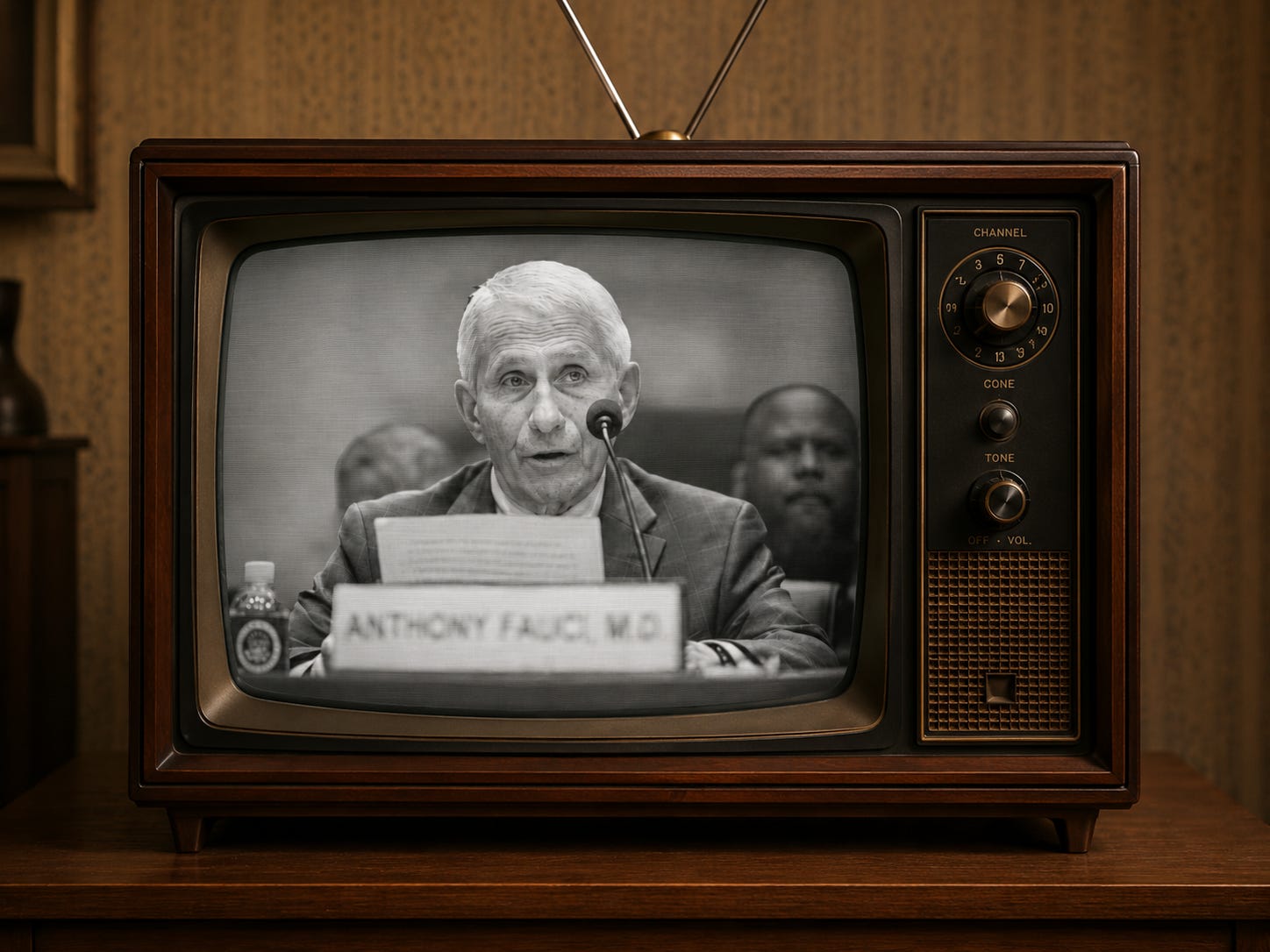
Dr. Anthony Fauci’s paternal grandparents, Antonino Fauci and Calogera Guardino, immigrated to the United States in the late 19th century from Sciacca, a port city on Sicily’s southwestern coast about an hour-and-a-half west of Ravanusa, an ancient town in the Sicilian hinterlands and the birthplace of Giuseppe Minacori and his wife Luigia Farrugio, who sailed across the Atlantic and then up the Mississippi River to New Orleans, where they started a new life in the new world under a new surname, Marcello.1
The coincidence has no legal significance. It is simply a remarkable historical rhyme.
Seventy-five years apart, two Americans with family roots in the same Sicilian province sat before hostile Senate committees whose members had already publicly associated them with serious crimes. Both men invoked the Fifth Amendment more than one hundred times. Both were threatened with contempt of Congress.
Marcello was actually indicted, convicted, and sentenced for contempt. Then the United States Court of Appeals for the Fifth Circuit reversed every remaining count and entered a judgment of acquittal.
That decision does not mean Fauci automatically possesses a valid privilege against answering every question Paul’s committee asked. President Joe Biden’s broad pardon of Fauci gives Paul an argument that did not exist in Marcello’s case. Nor does hostility by a senator, standing alone, excuse a witness from testifying.
But the central holding of Marcello’s appeal remains devastating to Paul’s sweeping contention that Fauci’s silence itself constitutes contempt:
Congress cannot publicly place a witness in the position of a criminal defendant, seek answers that may help construct a prosecution, and then make the witness’s reliance on the Fifth Amendment a crime.
Marcello’s case is not binding precedent on a federal court in Washington. It is a 1952 Fifth Circuit decision. But it rests on a national constitutional rule announced by the Supreme Court—and modern law is, in one important respect, more protective of Fauci than the law Marcello confronted.
Congress had already decided what Fauci was
On July 29, 2026, Fauci appeared under subpoena before the Senate Committee on Homeland Security and Governmental Affairs. He announced at the beginning that he would invoke his Fifth Amendment privilege and then did so repeatedly throughout the approximately three-hour hearing. Contemporary accounts placed the number of invocations above one hundred.2
Fauci was not appearing before legislators who had approached his conduct with detached curiosity.
Paul had previously referred Fauci to the Justice Department for possible criminal prosecution, alleging that Fauci lied under oath during earlier Senate testimony concerning National Institutes of Health support for research in Wuhan. In 2025, Paul renewed that referral and simultaneously questioned the validity of Biden’s pardon, arguing that the Justice Department should investigate whether it had been properly authorized.3
Paul later accused Fauci of directing federal employees to destroy official records, concealing information from congressional investigators, misleading Congress, and participating in what Paul called a pandemic “coverup.” These remain allegations. They have not been established by a criminal conviction or judicial finding. But for Fifth Amendment purposes, their importance lies in the fact that the committee chairman had already identified criminal theories and publicly advocated prosecution before compelling Fauci to testify.
Senator Josh Hawley added another set of accusations during the hearing. Hawley alleged that Fauci unlawfully used government employees and resources to pursue personal cash awards, repeatedly juxtaposing those allegations with the words “a million people dead.” Paul ended the hearing by asking whether Fauci’s actions had led to “the largest man-made plague in human history.”4
Neither senator literally presented Fauci with a murder indictment. Neither proved that Fauci created SARS-CoV-2, caused the pandemic, destroyed government records, illegally enriched himself, or lied under oath. The origins of the pandemic remain disputed, and the senators’ allegations must remain identified as allegations.
But their theory of culpability was unmistakable. Fauci was being placed within a narrative in which federally supported research may have produced or contributed to a man-made virus; Fauci allegedly concealed or minimized that possibility; he allegedly misled Congress and the public; and the resulting pandemic killed more than one million Americans and millions more throughout the world.
That is not a neutral legislative inquiry. It is at least potentially an evidence-gathering proceeding against a publicly designated criminal target.
Fauci explained his position in precisely those terms. He said Paul had repeatedly demanded his prosecution and imprisonment and that the apparent purpose of the hearing was to induce him to say “something, anything” that could vindicate Paul’s pledge that Fauci should end up “behind bars.” Paul responded that Fauci’s pardon eliminated any legitimate basis for silence, warned that there would be repercussions, and announced that the committee would consider contempt proceedings.5
The question is not whether Paul sincerely believes his accusations. Nor is it whether Fauci is innocent of every conceivable offense.
The constitutional question is whether truthful answers could provide evidence—or links to evidence—that might be used in a criminal prosecution.
Carlos Marcello’s case explains why that distinction matters.
Why Marcello was charged with contempt
On January 25, 1951, Marcello appeared before a subcommittee of Senator Estes Kefauver’s Special Committee to Investigate Organized Crime in Interstate Commerce in New Orleans.
Marcello supplied his name and address. When asked to produce tax returns, financial records, and other documents, he read a prepared declaration saying that he would refuse to answer further questions or produce records because they might incriminate him.
The committee proceeded anyway.
Later accounts frequently state that Marcello invoked the Fifth Amendment 155 times. The controlling appellate opinion gives a different number: the committee propounded “some 166 specific questions,” each of which Marcello refused to answer.
The number ultimately had no constitutional importance. Congress did not prosecute him merely because he had repeated the same invocation many times. It prosecuted him because the committee concluded that particular assertions of privilege were invalid, directed him to answer, and treated his continued refusal as a violation of the federal contempt statute.6
That statute, now codified at 2 U.S.C. § 192, makes it a misdemeanor for a properly summoned witness willfully to refuse to answer a question pertinent to a congressional inquiry. The statute does not erase the Fifth Amendment. If the answer is constitutionally privileged, the refusal is not criminal contempt.
Marcello was indicted on forty-nine separate counts. He waived a jury and stood trial before a federal judge. The judge acquitted him on forty-three counts but convicted him on six.
Those six questions asked whether Marcello had an indictment pending against him; whether he had ever traveled outside Louisiana; whether he knew Salvatore Vittali; whether he had an interest in the Beverly Club; whether he had previously said that his investment in that club amounted to between $40,000 and $50,000; and whether he had said he purchased the New Southport Club from Victor Trapani for between $160,000 and $165,000.7
Several of these sounded harmless in isolation.
Travel outside Louisiana is not necessarily criminal. Knowing another person is not necessarily criminal. Having an interest in a business is not necessarily criminal.
The trial judge concluded that Marcello had failed to demonstrate a reasonable danger from answering the first three questions. As to the business questions, the judge ruled that Marcello had waived the privilege by previously discussing the same businesses with an FBI agent in 1948.
The Fifth Circuit rejected both conclusions.
Marcello was functionally the accused
The appellate court first resolved an issue in the government’s favor: the committee possessed legitimate authority to investigate organized crime, and the six disputed questions were pertinent to that investigation.
Marcello did not prevail because Congress was powerless to investigate him.
He prevailed because the Fifth Circuit refused to pretend that the questions had been asked in a vacuum.
Before Marcello took the witness chair, newspapers had called him Louisiana’s Mafia leader, its leading racketeer, a “crime czar,” and the beneficiary of a regional criminal monopoly. New Orleans Mayor deLesseps Morrison testified about what he called the “Kastel-Marcello axis,” encompassing casinos, racing information, coin-operated machines, and related enterprises. Kefauver announced during the proceeding that investigative reports identified Marcello as one of the principal criminals in the United States.
The court examined that publicity, the official accusations, the committee’s declared purpose, the criminal subjects under investigation, and the relationships among the questions. It concluded that Marcello’s actual position was “markedly similar to that of an accused in a criminal trial.”8
That characterization was decisive.
Only months earlier, the Supreme Court had decided Hoffman v. United States. The Court held that the Fifth Amendment protects more than answers that directly confess a completed crime. It also protects answers that could furnish a link in the chain of evidence needed to prosecute the witness.
A judge may reject the privilege only when, after considering the question and all surrounding circumstances, it is perfectly clear that the answer cannot possibly tend to incriminate the witness. The witness cannot be required to explain the danger so fully that the explanation itself supplies the incriminating information.9
The Fifth Circuit applied that test question by question.
An answer concerning Marcello’s travel outside Louisiana could help establish interstate activity, meetings, transactions, or federal jurisdiction. Acknowledging that he knew Vittali could connect him with a person then associated with a murder investigation, flight from prosecution, or other potentially federal conduct. Statements about Marcello’s investments in the Beverly and New Southport clubs could connect him to gambling income, concealed ownership, tax liability, interstate racketeering, or other criminal activity under investigation.
None of those answers, standing alone, necessarily proved a crime.
That was not the standard.
It was enough that an answer might advance the investigation, identify another source, establish part of an element, authenticate an earlier statement, or provide a link that prosecutors could combine with other evidence.
The Fifth Circuit also rejected the government’s waiver theory. Whatever Marcello had voluntarily told an FBI agent in 1948 did not permanently surrender his privilege in every subsequent proceeding. By 1951, the setting had changed dramatically. Marcello was now the publicly identified target of a national organized-crime investigation. Repeating or expanding upon the earlier information could create new criminal consequences.
The court reversed all six convictions and entered a judgment of acquittal. It did not order another trial. It determined that the Constitution protected the refusals on which the convictions rested.10
Hostility alone is not the rule
Marcello did not win merely because Kefauver disliked him.
The Fifth Amendment does not give every witness a right to refuse questions posed by a sarcastic, angry, partisan, unfair, or grandstanding senator. Congressional hearings are often adversarial. Legislators may confront witnesses with damaging documents, challenge implausible answers, and announce that they believe misconduct occurred.
The committee’s hostility mattered in Marcello’s case because it demonstrated something more legally consequential: the proceeding had placed Marcello in the functional position of an accused person.
Kefauver’s committee had publicly identified the crimes it associated with Marcello. It had described the organization it believed he controlled. It was seeking the names, businesses, movements, financial interests, and relationships needed to complete that criminal picture.
The setting converted otherwise neutral facts into potentially incriminating evidence.
The same distinction applies to Fauci.
Paul’s criminal referrals, demands for prosecution, allegations of false testimony, claims of destroyed records, attacks on the pardon, and rhetoric about a man-made plague do not automatically validate every invocation Fauci made. They do, however, make it exceedingly difficult to argue that Fauci’s fear of prosecution is imaginary.
Hawley’s questions concerning federal employees, government resources, personal awards, and financial benefits were likewise framed as accusations of unlawful self-dealing. A truthful answer concerning who directed an employee, how an award application was prepared, what government resources were used, whether an ethics office was contacted, or what Fauci understood the governing rules to be could help establish knowledge, intent, authorization, benefit, or concealment.
Paul’s substantive questions concerning Wuhan research, federal funding, official communications, records retention, and previous congressional testimony carry the same potential. If prosecutors were later to pursue false-statement, records, obstruction, fraud, or conspiracy charges, the answers Paul demanded might become evidence or reveal where other evidence could be found.
The more explicitly senators insist that the witness committed serious crimes, the harder it becomes for them to maintain that his answers could not possibly incriminate him.
The problem with Fauci’s blanket invocation
This does not necessarily mean Fauci was entitled to refuse every question.
Hawley asked him what day of the week it was, what color tie he was wearing, and what color the carpet was. Those answers, by themselves, would ordinarily present no plausible danger of incrimination.
But that maneuver creates a different problem for a contempt prosecution. Section 192 applies only to a refusal to answer a question pertinent to the subject under congressional inquiry. The color of Fauci’s tie and the color of the carpet were presumably tests or political theater, not evidence concerning the origins of COVID-19, federal research grants, records preservation, or pandemic policy.
Paul therefore faces a difficult divide:
Questions that are genuinely pertinent to his announced investigation frequently concern the very conduct he has called criminal and may therefore be protected.
Questions that are manifestly harmless may be too trivial or irrelevant to support the statutory requirement of pertinency.
A prosecutor cannot simply aggregate more than one hundred invocations and tell a jury that the number proves contempt. Each criminal count must identify a particular question, establish its pertinency, demonstrate a clear direction to answer, and overcome the constitutional privilege applicable to that answer.
Marcello’s forty-nine-count indictment is the warning. Prosecutors charged forty-nine refusals. The trial court rejected forty-three. The Fifth Circuit rejected the remaining six.
Volume is not validity.
Paul’s pardon argument is substantial—but incomplete
Paul’s strongest legal argument is President Biden’s pardon.
On January 19, 2025, Biden granted Fauci a full and unconditional pardon for any federal offenses he may have committed or participated in between January 1, 2014, and the date of the pardon, provided that the offenses arose from or related to Fauci’s service as director of the National Institute of Allergy and Infectious Diseases, his membership on the White House coronavirus bodies, or his service as chief medical adviser to the president.11
A valid pardon ordinarily eliminates the danger of federal prosecution for the offenses it covers. The Supreme Court stated long ago that a witness who has been pardoned may not rely on the Fifth Amendment with respect to the pardoned offense because the criminal jeopardy has been removed.12
Paul is therefore correct about an important proposition: Fauci cannot invoke the Fifth solely to avoid admitting a completely pardoned federal offense when no other realistic criminal exposure remains.
But Paul treats that proposition as though Biden granted Fauci immunity from every possible prosecution by every government for every act at every point in time. The warrant does not say that.
First, a president may pardon only offenses against the United States. Presidential clemency does not reach state crimes.
That distinction became concrete immediately after the hearing. Florida Attorney General James Uthmeier announced that his office was opening an investigation into Fauci. The announcement did not identify a specific charge, establish that a viable state crime exists, or resolve substantial questions of jurisdiction, limitation periods, causation, federal-officer immunity, and proof. It is not evidence of Fauci’s guilt.
It does, however, undermine Paul’s categorical insistence that no government could possibly prosecute Fauci. A court evaluating the privilege would have to determine whether state exposure was real and reasonable—not merely accept the committee chairman’s assurance that the federal pardon settled everything.13
Second, the pardon has temporal limits. It ends on January 19, 2025. It does not cover an offense committed afterward.
Third, its substantive language is broad but not limitless. It covers offenses arising from or related to Fauci’s specified government positions. A question that reaches conduct beyond those roles—or connects pardoned conduct to potentially unpardoned conduct—would require an independent analysis.
Fourth, Paul himself has challenged the pardon’s legal validity. In renewing his referral, he asked the Justice Department to investigate whether Biden personally authorized it.
Paul cannot comfortably maintain both propositions at once:
The pardon may be invalid, so Fauci can still be federally prosecuted.
The pardon is so comprehensive and conclusive that Fauci has no Fifth Amendment privilege.
If Paul is right that the pardon may be invalid, the federal criminal danger he has repeatedly invoked remains alive. If the pardon is valid, it may defeat federal exposure within its scope, but not automatically every possible state or post-pardon theory.
The Fifth Amendment also does not protect Fauci from prosecution for perjury or false statements he might commit while testifying now. A witness may not remain silent merely because he fears that he will lie. The privilege protects truthful testimony that could expose him to criminal liability; it does not authorize false testimony.
But this limitation does not solve Paul’s problem. The questions at issue were not merely invitations to commit future perjury. Many sought truthful answers about conduct Paul had already characterized as criminal.
Modern law strengthens one part of Marcello’s argument
There is an additional historical irony.
When the Fifth Circuit decided Marcello’s appeal in 1952, Supreme Court doctrine concerning one sovereign’s use of testimony compelled by another was less protective than it is today. The Marcello court openly criticized the idea that a witness might be forced to choose among contempt, perjury, or testimony that could send him to a state penitentiary merely because a federal committee had compelled the answer.
In 1964, the Supreme Court resolved the problem in Murphy v. Waterfront Commission. It held that one government cannot compel testimony over a valid Fifth Amendment claim and then leave another sovereign free to use that testimony against the witness. Compelled testimony must be protected against prosecutorial use across the federal-state boundary.14
That means the modern inquiry cannot end with Paul’s assertion that Biden eliminated federal liability. If a truthful answer could reasonably expose Fauci to a state prosecution, the Fifth Amendment remains implicated unless adequate immunity also protects him from that use.
The Florida announcement does not prove that such a prosecution could succeed. It does mean that a court cannot dismiss the state question without examining it.
Why Paul’s sweeping contempt theory is likely doomed
Paul may secure a committee vote. As of July 31, the committee had scheduled an August 5 business meeting whose first listed agenda item was a resolution concerning contempt of Congress.15
A committee resolution, however, is not a criminal conviction. It does not settle the Fifth Amendment question.
For a sustainable prosecution under § 192, the government would need to proceed count by count and prove that:
Fauci was lawfully summoned;
the particular question was pertinent to the authorized inquiry;
he was clearly directed to answer;
his refusal was willful; and
the Fifth Amendment did not protect the answer.
The committee’s announced theory—that Biden’s pardon eradicated the privilege across the entire hearing—is too broad.
A court would have to examine the pardon’s dates, its relationship-to-service language, Paul’s challenge to its validity, potential state exposure, each question’s subject matter, and the ways a truthful answer could provide evidence or investigative leads.
A narrowly drafted contempt count might conceivably survive. A court could find that a particular question was pertinent, wholly confined to pardoned federal conduct, incapable of exposing any state or post-pardon offense, and unsupported by any reasonable fear of incrimination.
But Paul’s existing record makes the larger prosecution extraordinarily vulnerable.
His committee did not merely seek a historical explanation. Paul had already referred Fauci for prosecution. He had alleged false testimony, destroyed records, obstruction, and a cover-up. He questioned the pardon because he wanted federal prosecution to remain possible. He then used the pardon as proof that Fauci had no right to protect himself from prosecution.
Hawley accused Fauci of unlawful self-dealing while repeatedly invoking the pandemic death toll. Paul ended by connecting Fauci to what he described as a man-made plague.
These statements do not prove Fauci committed a crime.
They do prove that Fauci was reasonable to understand himself as the accused.
That is the same constitutional circumstance the Fifth Circuit recognized in Marcello’s case.
Congress already has a lawful solution
Congress does not have to choose between accepting Fauci’s silence and prosecuting him for asserting the Fifth Amendment.
Federal law provides a procedure for compelling testimony under immunity.
Under 18 U.S.C. §§ 6002 and 6005, an authorized congressional committee may request a federal court order requiring a witness to testify. Once the order takes effect, the witness may no longer refuse on Fifth Amendment grounds. In exchange, neither the compelled testimony nor evidence derived from it may be used against the witness in a criminal case, except in a prosecution for perjury, a false statement made during the immunized testimony, or refusal to obey the order.16
The Supreme Court upheld this form of use-and-derivative-use immunity in Kastigar v. United States, holding that it is coextensive with the protection supplied by the Fifth Amendment.17
That is the constitutionally honest route.
If Paul’s primary objective is to learn what Fauci knows, Congress can seek an immunity order broad enough to eliminate the criminal danger and then compel answers.
If Paul refuses to immunize Fauci because he wants the answers preserved for possible prosecution, he validates the reason Fauci invoked the Fifth.
Congress cannot simultaneously say:
Your testimony cannot incriminate you, so you must answer.
and:
We need your answers so that you can finally be prosecuted.
One purpose defeats the other.
The Constitution protects the accused before the indictment
Carlos Marcello was a convicted criminal and a powerful organized-crime figure. The Fifth Circuit did not exonerate him from the broader allegations surrounding his gambling interests, businesses, or underworld associations. It did not admire him or find that the Kefauver Committee had treated him politely.
It held something narrower and more important: Congress had placed Marcello in the functional position of a criminal defendant and could not make him help construct the case against himself.
Anthony Fauci is not Carlos Marcello. Their careers, conduct, public reputations, and places in American history could scarcely be more different. The comparison is constitutional, not moral.
But constitutional rights do not depend on whether the witness is sympathetic. They do not disappear when senators believe they have finally cornered someone they despise. And they do not become crimes because the witness invokes them repeatedly.
The historical coincidence remains extraordinary.
Fauci’s grandparents came from Sciacca. Marcello’s parents came from Ravanusa. Their families reached America from the same Sicilian province.
Generations later, each man sat at a Senate witness table while lawmakers described him as the embodiment of a national menace.
Kefauver’s committee called Marcello one of the principal criminals in America.
Paul asked whether Fauci had helped cause the largest man-made plague in human history.
Both committees wanted answers. Both also contemplated prosecution. Once those objectives converged, the Fifth Amendment became more—not less—important.
Congress may investigate. It may subpoena witnesses, expose contradictions, test explanations, and grant immunity when the public interest requires testimony.
What it may not do is publicly convert a witness into the accused, demand that he furnish the evidence against himself, and then declare his reliance on the Constitution to be a crime.
Tsounis, Catherine. “Dr. Despina Siolas Attended Meeting with Dr. Anthony Fauci.” Hellenic Daily News, 11 May 2023. Fauci is quoted identifying Sciacca, in Agrigento, as his grandparents’ hometown. See also “Antonino Fauci (1874–1960)” and “Calogera ‘Lillie’ Guardino (1873–1952).” FamilySearch. A 25 July 1956 U.S. State Department nationality memorandum records Giuseppe Minacori and Luigia Farrugio as natives of Ravanusa, Province of Agrigento.
United States, Congress, Senate, Committee on Homeland Security and Governmental Affairs. “Testimony of Anthony Fauci.” 29 July 2026. U.S. Senate Committee on Homeland Security and Governmental Affairs. Accessed 31 July 2026. Walsh, Joe, Kathryn Watson, and Caitlin Yilek. “Dr. Anthony Fauci Invokes 5th in COVID Hearing, Citing Rand Paul’s ‘Unhinged Obsession with Me.’” CBS News, 29 July 2026.
Paul, Rand. “Senator Rand Paul Re-Refers Dr. Anthony Fauci to the Department of Justice.” U.S. Senate Committee on Homeland Security and Governmental Affairs, 14 July 2025. Paul, Rand. “Chairman Rand Paul Uncovers New Evidence of Fauci Deleting Official Records, Calls Him to Testify Before HSGAC.” U.S. Senate Committee on Homeland Security and Governmental Affairs, 12 Sept. 2025. These documents state Paul’s allegations and prosecutorial demands; they are not judicial findings that the alleged offenses occurred.
Hawley, Josh. “Hawley Exposes Fauci’s Self-Dealings, Fauci Pleads the Fifth.” Office of Senator Josh Hawley, 29 July 2026. Walsh, Watson, and Yilek. Hawley’s page preserves his allegations concerning cash awards, federal resources, and the pandemic death toll. CBS’s live report records Paul’s concluding “man-made plague” statement.
Walsh, Watson, and Yilek. Fauci’s opening statement, Paul’s warning of repercussions, and Paul’s announcement of a forthcoming contempt vote are reported in the contemporaneous hearing coverage.
Marcello v. United States. 196 F.2d 437. U.S. Court of Appeals for the Fifth Circuit. 22 Apr. 1952, pp. 437–45. The opinion states that Marcello received approximately 166 questions, was indicted on forty-nine counts, acquitted on forty-three, and convicted on six. The complete uploaded opinion has been reviewed as the controlling source.
Marcello v. United States, 196 F.2d 437–39. The six counts concerned a pending indictment, travel outside Louisiana, Salvatore Vittali, an interest in the Beverly Club, a prior statement concerning that investment, and a prior statement concerning the New Southport Club purchase.
Marcello v. United States, 196 F.2d 440–42. The opinion recounts Kefauver’s accusations, the Drew Pearson coverage, Mayor Morrison’s testimony concerning the “Kastel-Marcello axis,” and the court’s conclusion that Marcello’s position resembled that of a criminally accused person.
Hoffman v. United States. 341 U.S. 479. Supreme Court of the United States. 28 May 1951, pp. 486–87. The Court held that the privilege extends to answers furnishing links in an evidentiary chain and may be rejected only when it is clear that the answer cannot possibly incriminate the witness.
Marcello v. United States, 196 F.2d 442–45. The Fifth Circuit rejected the government’s contention that Marcello’s 1948 FBI statement waived the privilege in the later Senate proceeding and reversed with instructions entering an acquittal.
Biden, Joseph R., Jr. “Executive Grant of Clemency: Dr. Anthony S. Fauci.” 19 Jan. 2025. U.S. Department of Justice. The warrant covers federal offenses from 1 January 2014 through 19 January 2025 arising from or related to Fauci’s enumerated federal positions.
Brown v. Walker. 161 U.S. 591. Supreme Court of the United States. 23 Mar. 1896, p. 599. The decision states the general proposition that a witness cannot maintain the privilege concerning an offense for which criminal jeopardy has been removed by a pardon or constitutionally sufficient immunity.
“Scope of Pardon Power.” Constitution Annotated, Library of Congress and Congressional Research Service. Presidential pardon authority extends only to federal offenses, not violations of state law. See also Office of the Pardon Attorney. “Frequently Asked Questions.” U.S. Department of Justice. Florida Attorney General James Uthmeier’s official office page reproduces his 29 July 2026 announcement of a Fauci investigation; as of 31 July, no specific charge or investigative process had been publicly identified.
Murphy v. Waterfront Commission of New York Harbor. 378 U.S. 52. Supreme Court of the United States. 15 June 1964, pp. 77–79. The decision prohibits one sovereign from compelling testimony while leaving another sovereign free to use the compelled evidence criminally.
United States, Congress, Senate, Committee on Homeland Security and Governmental Affairs. “Business Meeting.” 5 Aug. 2026. The published agenda lists a proposed resolution concerning contempt of Congress as its first legislative item.
United States Code. Title 18, secs. 6002 and 6005. Section 6005 establishes the procedure for obtaining a court order compelling congressional testimony; section 6002 prohibits criminal use and derivative use of testimony compelled under that order, apart from perjury, false-statement, and noncompliance prosecutions.
Kastigar v. United States. 406 U.S. 441. Supreme Court of the United States. 22 May 1972, pp. 453–62. The Court held that use-and-derivative-use immunity is coextensive with the Fifth Amendment privilege and places the burden on prosecutors to establish sources independent of compelled testimony.
Well done. Thanks for bringing your unique background to bear on this very contemporary set of issues.